

“Make a wish—there’s a shooting star!” On the night of August 12–13, 2026, you’ll have plenty of opportunities to do just that.
This year’s Perseid meteor shower will offer exceptional viewing conditions. With the Moon in its new phase, there will be no moonlight to wash out even the faintest meteors. Under truly dark skies, away from city lights, you can expect to see around 50 to 80 meteors per hour.
All you need is a blanket, a comfortable spot with an unobstructed view of the sky, and a little patience.
If you’re watching from the centre of Prague, Brno, or Ostrava, however, you’ll probably only catch the brightest meteors. Streetlights and urban light pollution dramatically reduce the contrast of the night sky, making fainter meteor trails nearly impossible to see. Even large city parks usually can’t eliminate this effect.
For the best experience, head at least several dozen kilometres away from major cities to a location with minimal light pollution and an open horizon.
Best Places to Watch the Perseids in the Czech Republic
The country’s three official Dark Sky Areas offer the best conditions:
- Jizera Mountains Dark Sky Area
- Beskydy Dark Sky Area
- Manětín Dark Sky Area
You’ll also find excellent viewing conditions in the less populated parts of the Jeseníky Mountains, Krkonoše, Beskydy, and Šumava National Park. More important than altitude is getting as far away from artificial lights as possible and finding a location with a clear view of the sky.
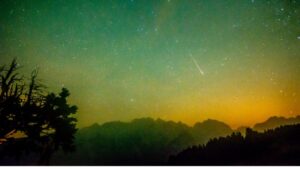
Perseids 2026: Everything You Need to Know
Active period: July 17 – August 24, 2026
Peak night: August 12–13, 2026
Astronomical peak: August 13, between 4:00 and 6:00 a.m. CEST
Best viewing time in the Czech Republic: Midnight until around 4:00–5:00 a.m.
Expected rate: Approximately 50–80 meteors per hour under dark skies
Moon phase: New Moon (ideal conditions)
Meteor speed: About 59 km/s (37 miles/s)
Equipment: None required—your eyes are all you need
Best locations: Jizera, Beskydy and Manětín Dark Sky Areas, as well as remote parts of the Jeseníky, Krkonoše, Beskydy and Šumava regions
Alternative viewing nights: August 11–12 and August 13–14
What Are the Perseids?
The Perseids are one of the world’s best-known annual meteor showers, often referred to in Central Europe as the “Tears of St. Lawrence.”
According to Christian tradition, Saint Lawrence, a Roman deacon, was ordered to hand over the Church’s wealth to Roman authorities. Instead, he distributed it among the poor and was executed on August 10, AD 258. Since the Perseids appear every August, legend says the streaks of light across the sky are the saint’s tears falling from heaven.
Scientifically, the explanation is rather different.
The Perseids occur every year when Earth passes through a stream of dust left behind by Comet 109P/Swift-Tuttle. Tiny particles, known as meteoroids, enter Earth’s atmosphere at extremely high speeds, burning up and creating the bright streaks of light we see as meteors.
Partial Solar Eclipse on August 12, 2026
Before the Perseids reach their peak, the Czech Republic will witness another remarkable celestial event—a deep partial solar eclipse.
Eclipse begins: Around 7:19 p.m. CEST
Maximum eclipse: Approximately 8:11–8:13 p.m. CEST
Sun covered: Roughly 85.5–87.1% of the Sun’s visible disc (depending on your location)
Exact New Moon: 7:37 p.m. CEST
Best visibility: Western and Central Bohemia; in eastern parts of the country, the Sun will be very low on the horizon or already setting
Viewing direction: West to northwest
Eye protection: Certified solar eclipse glasses or an approved solar filter are essential
Safety warning: Ordinary sunglasses do not provide adequate protection. Looking directly at the Sun without proper eye protection can cause permanent eye damage.
The eclipse will begin across most of the Czech Republic at around 7:19 p.m., reaching its maximum just minutes before sunset. Depending on your location, the Moon will cover approximately 85–87% of the Sun’s surface.
Interestingly, the New Moon occurs during the eclipse itself, not afterwards. A solar eclipse is only possible when the Moon passes directly between Earth and the Sun during its new phase. The exact New Moon takes place at 7:37 p.m. CEST, between the beginning and the peak of the eclipse.
A few hours later, that same New Moon will provide perfectly dark skies for the Perseid meteor shower.
Why Is This Combination So Rare?
Although the Perseids return every August and solar eclipses occur somewhere on Earth every year, witnessing both events on the same day is far less common.
For such a coincidence to happen, several independent astronomical conditions must align perfectly.
Czech astronomer Petr Horálek explains:
“From a long-term statistical perspective, a total solar eclipse falls on the same calendar date only once every 100 to 400 years, although the interval varies considerably. If we focus specifically on the Perseid peak, which occurs around August 12 each year, this is an exceptionally rare event. The next similar coincidence will happen in the United States in 2045, but after that humanity won’t experience another one until the year 2937.”
In other words, August 12, 2026, offers an extraordinary combination of celestial events. Excellent Perseid viewing conditions occur from time to time, but the alignment of a solar eclipse, the exact New Moon, and the peak of one of the year’s most spectacular meteor showers—all within a single evening and night—is truly exceptional.
Photo: Canva
